
Together in Life
All projects
Cambodian cashew farmers and raw crop at collection

CashewNotes

Safeguarding commodity farmers worldwide.

About this project

The idea

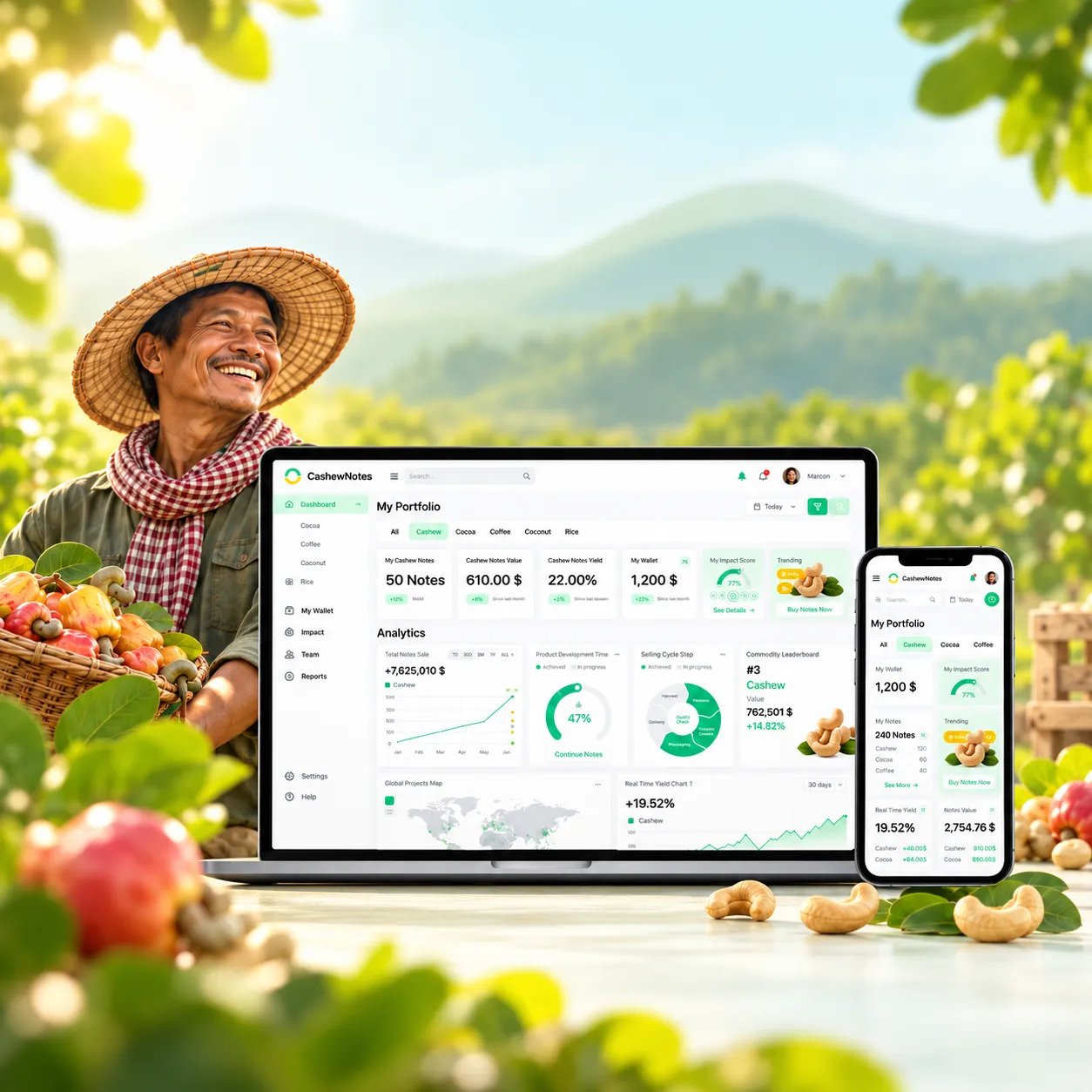
CashewNotes is an asset-backed financial instrument designed to finance commodity value chains while improving the livelihood of farmers and keeping more of the value created by agriculture within producing countries.

The model was developed around Cambodia's cashew sector.

Each Cashew Note represents the equivalent of one kilogram of processed cashew kernels. The capital raised through the Notes is used to purchase raw cashew nuts directly from Cambodian farmers at a predetermined price above the prevailing market price, giving farmers better income and greater protection from short-term price fluctuations.

The cashews are then processed and packed locally in Cambodia and sold under Cashewness, CashewNotes' premium Cambodian consumer brand. Once the products are sold, the profit generated through the cycle is returned to the holders of the Notes.

The model connects investment directly to a physical commodity and to the commercial activity that generates the return.

For farmers, it creates a buyer able to commit capital before processing and pay better prices for their production. For the local economy, it supports processing, packaging, employment, product development, and the creation of Cambodian brands instead of exporting most of the value chain together with the raw commodity. For Note holders, it creates the possibility of earning a financial return from the same commercial activity.

CashewNotes also works with farmers on the longer-term conditions behind their production. This includes better agricultural practices, diversification, intercropping, agroforestry, soil and water management, and the progressive development of additional income sources and cashew by-products.

The model is designed to be measurable. CashewNotes tracks both financial performance and concrete impact, including farmer income, income stability, employment, education, forest conservation, avoided emissions, biodiversity, soil health, and the adoption of more sustainable agricultural practices.

Cashew is the first commodity. The same financial structure is intended to be progressively adapted to other agricultural commodities where access to working capital, weak local processing, price instability, and an unequal distribution of value create similar problems.

An urgency to act

Cambodia has become one of the world's major producers of raw cashew nuts, but most of that production still leaves the country before it is processed. This means that Cambodia produces the agricultural raw material while a significant part of the value created through processing, branding, distribution, and retail is captured elsewhere.

For farmers, the problem starts earlier, cashew production requires land, labour, inputs, and time, but farmers remain exposed to market prices once the harvest arrives. Their need for immediate cash often limits their ability to negotiate and creates financial stress that in some cases can lead to bankruptcy. Processors face a different problem: purchasing large quantities of raw cashew nuts during a relatively short harvest period requires substantial working capital, and consequent and expensive storage facilities.

These problems are directly connected.

Without sufficient capital, local processors cannot purchase and process enough Cambodian production. Without stronger local processing and access to markets, farmers remain dependent on the raw commodity trade. Without higher-value final products, there is less value available to distribute across the Cambodian value chain.

CashewNotes addresses this financing gap at the beginning of the cycle.

Capital from Note holders finances the purchase of the raw commodity. Farmers receive a predetermined above-market price. The commodity is processed locally into a higher-value product. CashewNotes develops the market for that product, and the profit generated through its sale provides the economic return behind the Notes.

The interests of the investor, farmer, processor, and market are therefore connected through the same commercial cycle.

Cambodia's National Cashew Policy identifies increased local processing and stronger access to markets as central requirements for the development of the sector. CashewNotes provides a market-based mechanism designed to contribute directly to both.

The longer-term objective is larger than cashew.

Agriculture produces enormous economic value, yet farmers in producing countries often capture only a limited part of it with over 450 millions commodity farmers living with under 2.5 USD per day. This disparity is putting global food production at risk. CashewNotes aims to demonstrate that financial instruments can be structured around real commodity value chains in a way that generates returns while directing capital toward farmers, local processing, and more sustainable agricultural production.

Together in Life's role

As part of farmer support within the CashewNotes model, 10% to 15% of overall Note sales is transferred to the Farmers' Fund, a support fund dedicated to the development of participating farmers as a group.

The Fund provides access to expertise, helps farmers obtain agricultural inputs at lower prices, supports the financing of machinery and equipment, and funds other initiatives that contribute to the development of the farming communities.

Together in Life manages the Fund together with representatives of CashewNotes, local farmer groups, and local government.

Status

Proof of concept successfully completed in Cambodia. Preparing for commercial scale-up.

The first pilot financed the purchase of 25 tonnes of raw cashew nuts, represented by 6,250 Cashew Notes.

The complete cycle was tested in real market conditions, producing a return of 19.2% over one commercial cycle year, providing the basis for the next stage of development.

CashewNotes is now preparing the notes regulatory framework, as well a larger-scale deployment, towards the progressive expansion of the model.

More projects

Previous projectBorn for GreatnessA project offering underprivileged youth the opportunity to dare and demonstrate sparks of greatness.Next projectFlorestaA profitable reforestation model built around an innovative financial instrument.
About this project